Friday, April 6, 2007

It's a Good Friday for Cheddar


Sometimes you're in a rush because your friend is supposed to be coming to visit and you're trying to finish off some schoolwork, which means you just want to eat whatever's easiest to extract from the fridge (somewhat overloaded at the moment after a pre-birthday $74.59 splurge at Fiesta Farms). And you don't want to heat anything up. So you start by piling a bunch of things onto a plate before realizing that a bowl would make more sense, particularly because some of the things you're pulling out are round and liable to roll off the plate. But despite this urgency to eat lunch, you will take the extra time to grab what's important: CHEESE, aka what remains of the small block of "X-tra Old."


When the cheese is unwrapped a few minutes after leaving the kitchen (after all the sweet-potato hummus has been scooped up with celery and you've eaten the greenhouse-grown mini Roma tomatoes), you'll find this particular aged Cheddar smells like good cheese. Your nose knows. And when you take a bite, its bold, salty flavour (with very slightly sheepy undertones) will take over your tastebuds with a singular Cheddar taste and remind you again of the deliciousness of this type of cheese. Yes, this nearly anonymous cheese you bought at the market on Saturday is very near to being perfect, helped by having good texture and the fact that it doesn't crumble the way some aged cheddars do. Which means that you can't help but want to tell people to go forth and eat good Cheddar this weekend. (Chase it with an apple if you can: the Washington State Galas are perfect right now.)

Sunday, April 1, 2007

Saturday morning at St. Lawrence Market

Yesterday was a Saturday and despite being up till nearly 3AM the previous night sitting around a campfire on the beach, I woke up at 7:20AM and decided that if I got dressed quickly and hopped on my bike, I could catch the 7:45AM ferry and make it to the farmer's market before the crowds. So I did and it was wonderful. Saturday mornings are special to me and it was so great to be up when the weekend still holds so much promise. And so it was that within a hour of waking up, I was in a foodie wonderland marvelling at the colours of fresh, local vegetables, the cuteness of pussywillow branches (such a symbol of spring), and tasting incredibly delicious cheese (the first food of the day to pass my lips!).

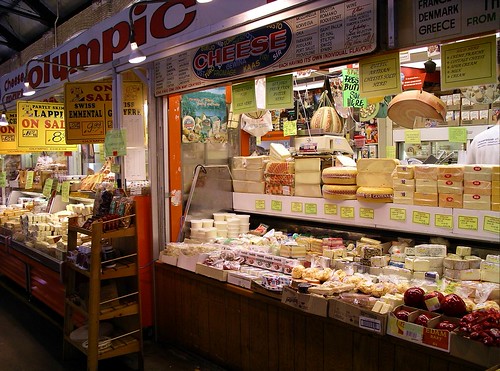
Amidst all the vegetable vendors, I came across a long table with a fantastic spread of different kinds of cheeses -- the majority of which could be sampled. I tried about 8 different kinds and settled on the four above. What led me to buy so many different kinds at once was the way that about a third of the cheese for sale was blocks that cost less than $3. Mind you, they're not huge pieces but for someone who's trying to broaden her cheese horizons, they're ideal: normally, I would feel bad buying such small quanties from a cheesemonger but this way I didn't have to. (Total cost for the cheese? $8.10)

I won't describe how they taste yet, despite the fact that I did try them all at the market, however, I will acknowledge that I am excited to try the Manchego, which was recommended by J.G., my co-worker in Vancouver, who says it's her favourite (not sure exactly how "aged" this one is but it tasted pretty sharp).

Cheeses on deck:
  • No. 12 - Manchego
  • N0. 13 - Extra Old Cheddar
  • No. 14 - 3-year-old Cheddar
  • No. 15 - Eweda Cru (Ontario raw sheep's milk cheese)

Nearly a cheese-free month (oops...)


First of all, apologies to those who keep checking back looking for updates only to find nothing new. I know it's been over a month but, to tell you the truth, I'm not sure what happened to March. I didn't eat a lot of cheese, that's for sure. In fact, all I can really remember consuming in the last month is:
  • a decent block of President's Choice organic white cheddar, which reminded me how much I love cheddar
  • molto mozzarella on a slice of veggie pizza from Pizza Gigi
  • whatever cheese was in the veggie lasagna that B. made to share with everyone in celebration of her 30th birthday on Tuesday
  • a good deal of chevre (I think) in the delicious purple cabbage(!) enchiladas (with tomatillo salsa!!) that T. made on Friday night
  • (very slowly) half a wedge of Tre Stelle Asiago, which was best melted on top of a loaf of homemade foccaccia that I made using this recipe (photo of bread below, but not from the loaf with cheese—that one disappeared too quickly!)

Tuesday, February 27, 2007

Man (and Woman, presumably) Can Live By Cheese Alone


If you can believe it, at the moment I'm too busy to eat cheese, let alone write about it. But to provide something new for my loyal readership (you know who you are!), I bring you breaking news from the world of cheese. According to this article in the Hunts Post, the extremely food-phobic 29-year-old Dave Nunley (see photo) survives pretty much exclusively on cheddar...

Saturday, February 17, 2007

Cheese No. 9

Number 9, number 9, number 9, number 9, number 9 Number 9, number 9, number 9, number 9, number 9 Number 9, number 9, number 9, number 9, number...
— The Beatles, "Revolution 9"

The combination of just missing the 7 o'clock ferry and having the weekend ahead of me, gave me the time and the incentive to shop for a new cheese last night. Despite the wide selection of varieties available at my local Loblaws, I decided to go with a cheese I've actually tried before*: Oka. Even though I feel like I should be trying to get into stinky cheeses at this point in the "project," my stomach's not so happy right now (there's some sort of flu-like thing going around where I'm living) so I decided to play it safe and go with something pretty mild. However, it's not cheating: if you check out my last post, you'll see that Oka's on my shopping list (a recommendation from S.).


Anyway, I sliced a piece off the not-so-cheap chunk of Oka Classic I bought last night to taste at lunch today. It was exactly what I was in the mood for cheese-wise: medium-firm, salty, not too creamy, and with a nice flavour. I'm a total chese novice so I don't care if it's wrong to make such a comparison but it reminded me of cheap brie that you've just taken out of the fridge: not too flavourful but salty enough and creamy enough to be delicious... before it gets all gooey and runny.

According to my research, Oka has a good story behind it. While the cheese is simply named after the village in Quebec where it's been made by monks since 1893, the recipe, however, comes from France. According to Wikipedia, following the seizure of their abbey by the Frech army and their expulsion from France, a group of eight monks emigrated to Canada in 1881 and set up a new order on a piece of land granted to them by the Grand Seminary of the Sulpician Order in Montreal, which had large land holdings. The exiled monks establ
ished l'Abbaye Cistercienne d'Oka and an affiliated agricultural school, and soon became well known for their Port-Salut-type cheese, made from a recipe they brought with them from Brittany.


You can visit the monastery and buy Oka directly from the monks at their store (which also sell chocolates made by nuns and cider made by another abbey), or you can purchase it from their online store. For just $58.25, plus $7.50 for shipping, you can get a 2.5-kilogram wheel delivered straight to your house, which will "amply serve 75 pe
rsons with generous portions." Sounds like a bargain to me.

* The first time I had Oka was on a hot summer day in Montreal during a day-long organized bike ride called Tour de l'Ile. There were two rest stops and one was sponsored by Quebec dairies so you could line up for free samples of chocolate milk and cheese, including packages of sliced Oka.

Monday, February 12, 2007

A Shopping List for St. Lawrence Market


- Saint-Andre (soft, triple cream)
- Epoisses (stinky)
- Pecorino di Pienza (semi-soft, aged)
- Applewood Smoked Cheddar (smoked)
- Gruyere (hard)
- Fleur du Maquis (fresh and mild)
- Oka (semi-soft, ripened)

Saturday, February 10, 2007

Cheeses No. 7 & No. 8


After describing a cheese plate he'd served to friends who'd come over for dinner, my co-worker B. surprised me the following day with samples of two of the more interesting varieties he'd included: Morbier and Sage Derby (pronounced "dar-bee").

I ended up eating them for lunch a few days later.

The first cheese I tried was the Sage Derby, mainly because it looked intimidating and I was scared it might taste like Blue cheese (which I find incredibly nasty). The cheese has a bright green waxy rind, that reminded me of the peel of a Granny Smith apple). It also features green marbling, which made me think of Blue cheese but this cheese wasn't as strong-smelling. In fact the flavour was totally different: herby (from the sage) with an almost minty aftertaste. With a texture similar to Gouda, it wasn't very salty, nor too creamy; "aromatic but not overwhelming" is how one online cheese broker describes it . It definitely looks bolder than it tastes!

Upon conducting a bit o' research (naturally), I learned this English cheese has its origins in the 17th century. The green colour comes from the addition of sage (an herb valued at the time for its supposed medicinal value), or from green corn "juice". Traditionally, Sage Derby was only made for special occasions like Christmas

I tried the Morbier (aka, "Cheese with a Dash of Ash") next. When B. had first given it to me and explained that the black line was "edible ash," I wanted to know how the ash was made. While Wikipedia didn't have the answer, the good folks at Hormel did:
The edible ash coatings are made by burning the wood of junipers, white pines, or grape vines, or the remains of vegetables such as bell peppers and eggplants to create a compound for the coating. The ash is then processed further by mashing or pounding it into a fine-textured powder that is dispersed over the area of cheese to be coated.
When I poked around a bit more, I learned the reason for the ash: traditionally, the cheese is made from the curds produced from two separate milkings, the morning milking and the afternoon/evening milking, and the line of ash separated the two. These days, the mass production of Morbier happens in factories that don't always adhere to that tradition so in those cases the ash is therefore purely decorative (though there are people who still make it the old way, which even the New York Times has written about).

When I finally got around to tasting the Morbier, I found it had a strong cheesy smell (un peu piquant peut-etre?) and was softer than the Derby (which had a texture/consistency similar to Gouda). It also had a more-overwhelming "umami": I thought it tasted more aged, saltier, and creamier than the Derby. I found the ash to be flavourless unless you can isolate it from the cheese (I was able to scrape some off with my fingernail) and then it's sort of peppery (like black pepper). The way it looked actually reminded me of photocopier toner (when it smears on a piece of white paper onto which you've just copied something).

BONUS: Think you know everything about Morbier (and can speak French), follow this link and try the "quizz"!