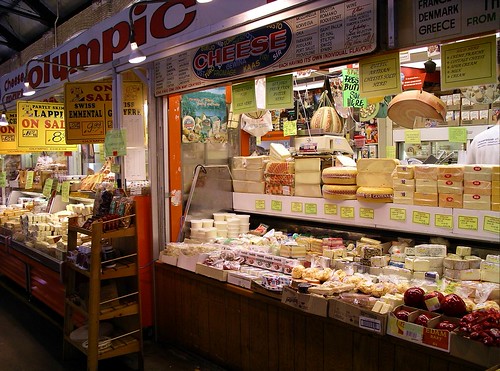
Showing posts with label hard. Show all posts

Monday, October 22, 2007

Always use the best ingredients

Reading the biography of Alice Waters reminded me that the best food starts with the best ingredients, which often means expensive. Not always, but with cheese it's usually the case. For example, pesto made with grocery-store pre-grated parmesan will never be as good (in my opinion) as pesto made with high-quality, imported-from-Italy, bought-from-a-cheesemonger Parmesan Reggiano, even if the former is dirt-cheap and the latter costs a bomb.
Having won a bit of money at a bike race yesterday, I decided to treat myself to some nice cheese to put in the pesto I was planning to make with the $0.99 fresh basil from Koreatown and pinenuts left over from our Montreal Thanksgiving meal. Even though the tiny 50-gram block I got cost more than all of the other ingredients combined, and I had to use it all up, it was worth it: the resulting pesto is fantastic.

Mimolette!

A couple posts back, I mentioned that a Toronto food critic's "desert island cheese" was mimolette and when my dad was in town I had the chance to try it. We were walking up Yonge St. to meet someone he used to work with and had some time to kill so I suggested we pop into All the Best, which typically has free samples on weekends. We were not disappointed: there was a guy handing out pasta and sauce just inside the door, slices of pickled beets a few steps away, and self-serve goat cheese and crackers towards the back of the store. We tried everything and it was all delicious but what caught my dad's eye was the mimolette for sale behind the cheese counter glass. James Chatto was right, the uncut cheese looks like a cross between a cannonball and a canteloupe. I didn't try any in the store but my dad did and was convinced by the taste to buy some. I'm glad he did and that he was willing to share.

I first tried the mimolette on its own and it was good: bright orange and salty, it was like a cross between aged cheddar and hard parmesan. In omelettes, for which I'm been won over to using hard cheeses, it was delicious. Not sure of its worthiness as a cheese with which to be marooned but worth a taste nonetheless.

Friday, September 14, 2007

Goodbye to summer


This really should be a blackberry and the background shouldn't be Parkdale but Metchosin but until I get the photos from my trip off my camera it will have to do...

I spent the last two weeks of August on Vancouver Island, a true "vacation" that climaxed with my brother's wedding on the first day of September (congrats to D & L!). Part of this trip, which will be detailed further this weekend, was devoted to discovering and enjoying local food and drink. This pursuit began nearly immediately when my dad insisted we stop to buy Silver Rill corn on the way home from the airport, then we stopped at a second farm market on Oldfield Road and I discovered that they grow figs in Victoria! And so kicked off an Island visit punctuated by delicious discoveries and tastings, including:
  • mead (Sooke)
  • blackberries (Galloping Goose Trail, Metchosin)
  • corn (Saanich Peninsula)
  • basil and yellow & green beans (backyard garden)
  • apples (frontyard orchard)
  • buffalo mozzarella (milk from Duncan, made in Courtenay)
  • blueberries (between Duncan & Ladysmith)
  • tomatillos (grown locally, bought at the Moss St. Market)
  • golden beets (grown locally, Luxton Farmer's Market)
  • garlic (Rocky Point Road, Metchosin)
  • hard cow's milk cheese (Parksville)
  • hard sheep's milk cheese (Cowichan Bay)
I also learned that you can invest in a cow at Little Qualicum Cheeseworks (Parksville), ate a very local-produce-friendly meal at The Superior (James Bay), and learned that my parents are planning an "100% Metchosin meal" (inspired by The 100-Mile Diet, whose authors they heard speak on Salt Spring Island). Needless to say, it was a wonderful visit.

Saturday, August 11, 2007

What's Your Desert Island Cheese?


About two weeks ago, in his Toronto Life blog review of C5, one of the new restaurants in the newly "crystallized" Royal Ontario Museum, food critic James Chatto mentioned that his favourite cheese is mimolette:

I was sitting in the ROM’s new restaurant, C5, late last week, when the mimolette question arose yet again. Properly aged mimolette is one of my absolute favourite cheeses. A whole one looks like a beaten-up stone cannonball until you prize it open. Inside, the paste is dark orange and so firm that it’s better to dig out fragments with a wedge than try to cut it with a knife. The flavour is bizarrely rich, like aged gouda only much more so—like hazelnuts and caramel and condensed milk and salt—incredibly delicious and with a finish as long and intense as Göttedamarung. I think it would be my desert island cheese. Indeed, I have always imagined this was the cheese that Ben Gunn fantasized about and begged for after his sad marooning.
Which makes me wonder, what's your desert island cheese?* Post your preference in the comments and I'll try to figure out what mine is...

*provided, of course, that your island came with a way of keeping the cheese from melting...

Tuesday, May 8, 2007

Cheese digest

As regular readers no doubt noticed, the cheeseblog took a break. But that doesn't mean I stopped eating cheese. Far from it. In fact, one of the best cheeses to date was something I sampled in the last month. To get us back up to speed, I'm providing briefer-than-usual cheese-tasting "blurbs," starting with my birthday purchase...


Cheese No. 16 - Frère Jacques
Killing time in Yorkville before catching a matinée of The Lives of Others on my birthday, I wandered into Pusateri's and picked out a nice piece of cheese on April 10th that ended up being quite tasty. I picked it sort of randomly: it looked good and the price was right. Turns out, it's another cheese with religious connections. This semi-soft cow's milk cheese is produced by Benedictine monks at the Saint-Benoit-du-lac Abbey in Quebec. According to the Abbey's website, "Saint Benedict said that to be a true monk, one must live by the work of one’s hands. Such work is meant to provide for the needs of the monastery and to maintain a happy balance of mind and body....The monks of Saint-Benoît-du-Lac assure their living above all by a cheese-factory, an orchard, a cider-factory, a farm and a store where their products are sold." These monks have been running a cheese factory since 1943!


Cheese No. 14 - 3-year-old Cheddar
I couldn't resist taking at least one photo of mouse and cheese - too goofy. Forgive me. According to my notes, I ate this mini-block on April 11th. The only other thing I wrote down was that it was "not as strong as the X-Old." Guess it wasn't that memorable.


Cheese No. 15 - Eweda Cru
I broke out the Eweda Cru on April 13th, this was the day I had to switch rooms, which was kind of traumatic in that I had to compress two rooms into one and give up my office. I thought eating some cheese might settle my stomach (but then I chased it with vitamins and coffee...) Anyway, I wrote down that the cheese was crumbly, slightly powdery, and not very "sheepy" at all. In fact, it reminded me of Asiago more than anything. It had a nice flavour: not so sharp, not that salty either - the website says "Comparable to: Young Pecorino Romano (but not as salty)" and a "traditional hard cheese."

I did find some time to poke around on the Ewenity Dairy Cooperative's website, mostly because I was curious about the raw milk thing. Essentially what this means is that the cheese is made from unpasteurised milk, which is okay because it's aged for just over 2 months. (Under Canadian law, any cheeses less than 60 days old must be pasteurised.) I also learned that sheep's milk contains more calcium, zinc and vitamins than other milks, which I suspect has to do with what the sheep eat. According to the website, the "main feedstuffs" of the co-op's sheep are "pasture (grasses, legumes, herbs and "weeds") and hay (dried pasture). At certain times of the year, the sheep are fed grain (barley, corn, oats or soybeans) as a supplement."

Friday, April 6, 2007

It's a Good Friday for Cheddar


Sometimes you're in a rush because your friend is supposed to be coming to visit and you're trying to finish off some schoolwork, which means you just want to eat whatever's easiest to extract from the fridge (somewhat overloaded at the moment after a pre-birthday $74.59 splurge at Fiesta Farms). And you don't want to heat anything up. So you start by piling a bunch of things onto a plate before realizing that a bowl would make more sense, particularly because some of the things you're pulling out are round and liable to roll off the plate. But despite this urgency to eat lunch, you will take the extra time to grab what's important: CHEESE, aka what remains of the small block of "X-tra Old."


When the cheese is unwrapped a few minutes after leaving the kitchen (after all the sweet-potato hummus has been scooped up with celery and you've eaten the greenhouse-grown mini Roma tomatoes), you'll find this particular aged Cheddar smells like good cheese. Your nose knows. And when you take a bite, its bold, salty flavour (with very slightly sheepy undertones) will take over your tastebuds with a singular Cheddar taste and remind you again of the deliciousness of this type of cheese. Yes, this nearly anonymous cheese you bought at the market on Saturday is very near to being perfect, helped by having good texture and the fact that it doesn't crumble the way some aged cheddars do. Which means that you can't help but want to tell people to go forth and eat good Cheddar this weekend. (Chase it with an apple if you can: the Washington State Galas are perfect right now.)

Monday, February 12, 2007

A Shopping List for St. Lawrence Market


- Saint-Andre (soft, triple cream)
- Epoisses (stinky)
- Pecorino di Pienza (semi-soft, aged)
- Applewood Smoked Cheddar (smoked)
- Gruyere (hard)
- Fleur du Maquis (fresh and mild)
- Oka (semi-soft, ripened)

Tuesday, January 30, 2007

Cheese No. 6

On Sunday afternoon, I visited the cutest, tiniest cheese store. When C. suggested that we check out this new cheese shop that had opened around the corner from her on Roncesvalles, I hadn't imagined it would be so small. In fact, I am writing this post from an office that feels bigger than the store! But crammed into Thin Blue Line's small space were a myriad of tasty treats -- fresh breads, olive oils, tapenades, crackers, salts -- and, of course, a small but well chosen selection of cheeses, many of which seemed to be Quebec-sourced. I was tempted to buy some Applewood Smoked Cheddar because that's on my list of recommended cheeses to try but I was on a mission for some Parmigiano Reggiano. Fortunately, TBL had a wheel in stock and was willing to accommodate my request for under 100g. I had come across a recipe for a chickpea salad on a foodblog I've started reading that called for it, and after reading this website, I was sold on only using the best of the best.

The cheese I purchased at TBL

The salad didn't blow my mind but it made for a pretty yummy lunch yesterday and I think I will try mixing the cheesy chickpeas with some spinach today to give it some crunch. However, as is the case with each cheese I try, in reading about the traditional cheese-making process for Parmigiano-Reggiano in Italy, I learned a couple of fascinating things:

1. Quality control involves a hammer
[T]he sound produced by the whole cheese when it is hammered by a special hammer is extremely important for an expert of Parmigiano-Reggiano. A trained ear is able to give a judgement about the inner structure of the whole cheese and its consistence: if the sound is hard the content of Parmigiano-Reggiano is homogeneous and compact, while if the sound is deep-toned and booming it's very likely that there are some swellings, bladders or empty zones; in this case the "whole cheese" is inevitably depreciated or it can also be rejected.
2. It aides the digestion of other foods
Parmigiano-Reggiano stimulates the gastric production thus helping to digest other foods, too. That’s why it is useful and correct eating flakes of Parmigiano-Reggiano as hors-d’oeuvre or at the end of the meal. 100 grams of Parmigiano-Reggiano are assimilated in 45 minutes (contrary to, for instance, 4 hours needed for the same quantity of meat)

3. It's another "place of origin" cheese
Parmigiano-Reggiano is strictly bound to its place of origin. Both the production of milk and its transformation into cheese take place in the provinces of Parma, Reggio Emilia, Modena, Bologna to the west of the Reno River and Mantua to the east of the Po River. The secret of such goodness originates in the place of origin, in the natural feed, and in the high quality milk with no additives.
Some Parmiagiano Reggiano statistics:
  • 20-24 average ageing of the wheels (in months)
  • 38 average weight of a wheel (in kg)
  • 16 litres of milk to make 1kg
  • 600 litres of milk to make one wheel
  • 3,136,191 number of wheels produced in 2005
BONUS READING: An interview with Gurth Pretty, the author of a book on Canada's artisanal cheeses

Sunday, January 21, 2007

Cheese Recommendations

"3 types of pecorino and honey" (courtesy Flickr)

Apologies to anyone who thought I would be trying a new type of cheese every day. At the moment, I'm having a hard time just remembering to buy cheese on a biweekly basis. After a year of not eating the stuff, you sort of fall out of the habit of including it on your grocery list and when I have tried to buy cheese recently, I am baffled by all the choices. However, I have been soliciting recommendations from friends and family. Here are some of the suggestions for what I should try, in the hope that by making them public I will eventually get around to trying them all...
  • "I recommend tracking down some Saint-Andre, a super-intense brie, and Epoisses, a stinky cheese par excellence. And if you're back on the West coast, check out Saltspring Island Cheese Company's Blue Joliette, which—though it looks disgusting—is surprisingly palatable."
  • "One of my favourite cheese treats is to get a few types of pecorino (Pienza, Tuscany makes the best), one old and hard, one medium, and one young and soft. then you get a couple of types of runny honey, slice the pecorino and drizzle honey over them. I like to mix and match the honey and cheese. YUM."
  • Applewood Smoked Cheddar
  • Gruyere
  • "As for cheese: you could always try the stuff we called "pikkeltjes kaas" as kids (roughly translated: "cheese with spots"). It’s also referred to a Leydse kaas (sp?) and is, I think, basically a Gouda with caraway seeds or fennel or some such thing in it. Very yummy. Then there’s always the stalwart Gouda. I remember living with an aunt in Amsterdam and being sent to the "kaas boer" (cheese farmer) at the street market for "jonge belegen" -- a young Gouda. (I’m not too sure what the "belegen" referred to...) Then there’s the old, old cheese with the black wax around the wheel. That one is trés yummy, but also trés expensive (at least, here in Canada)..."
  • "Lately... I've been buying goat brie, which has opened up all sorts of possibilities for me. I also bought some fig preserve, which goes really well with the brie - highly recommended!"
Please feel free to post your recommendations in the comments section...