Showing posts with label smoked. Show all posts

Monday, February 12, 2007

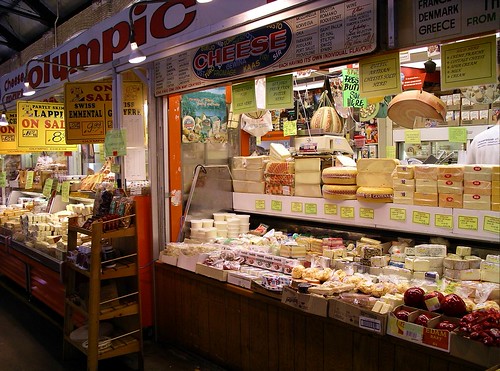
A Shopping List for St. Lawrence Market


- Saint-Andre (soft, triple cream)
- Epoisses (stinky)
- Pecorino di Pienza (semi-soft, aged)
- Applewood Smoked Cheddar (smoked)
- Gruyere (hard)
- Fleur du Maquis (fresh and mild)
- Oka (semi-soft, ripened)

Sunday, January 21, 2007

Cheese Recommendations

"3 types of pecorino and honey" (courtesy Flickr)

Apologies to anyone who thought I would be trying a new type of cheese every day. At the moment, I'm having a hard time just remembering to buy cheese on a biweekly basis. After a year of not eating the stuff, you sort of fall out of the habit of including it on your grocery list and when I have tried to buy cheese recently, I am baffled by all the choices. However, I have been soliciting recommendations from friends and family. Here are some of the suggestions for what I should try, in the hope that by making them public I will eventually get around to trying them all...
  • "I recommend tracking down some Saint-Andre, a super-intense brie, and Epoisses, a stinky cheese par excellence. And if you're back on the West coast, check out Saltspring Island Cheese Company's Blue Joliette, which—though it looks disgusting—is surprisingly palatable."
  • "One of my favourite cheese treats is to get a few types of pecorino (Pienza, Tuscany makes the best), one old and hard, one medium, and one young and soft. then you get a couple of types of runny honey, slice the pecorino and drizzle honey over them. I like to mix and match the honey and cheese. YUM."
  • Applewood Smoked Cheddar
  • Gruyere
  • "As for cheese: you could always try the stuff we called "pikkeltjes kaas" as kids (roughly translated: "cheese with spots"). It’s also referred to a Leydse kaas (sp?) and is, I think, basically a Gouda with caraway seeds or fennel or some such thing in it. Very yummy. Then there’s always the stalwart Gouda. I remember living with an aunt in Amsterdam and being sent to the "kaas boer" (cheese farmer) at the street market for "jonge belegen" -- a young Gouda. (I’m not too sure what the "belegen" referred to...) Then there’s the old, old cheese with the black wax around the wheel. That one is trés yummy, but also trés expensive (at least, here in Canada)..."
  • "Lately... I've been buying goat brie, which has opened up all sorts of possibilities for me. I also bought some fig preserve, which goes really well with the brie - highly recommended!"
Please feel free to post your recommendations in the comments section...

Wednesday, January 17, 2007

Lesson No. 1: The Colour of Cheese

A comment by my brother wondering about what's in that smoky liquid that my Jarlsberg was dipped in to give it a brown coating got me thinking about how cheese is coloured.

As a kid, I remember being somewhat blown away to find out that Cheddar wasn't naturally orange. Wish I'd know about this website back then. I just accepted that it was dyed orange with chemicals but it turns out the reason for that colour isn't artificial, rather it's due to the addition of a pigment made from the "bright red outer covering of the seeds of a tropical plant." A few drops of vegetable dye made from Bixin (or, Annatto, after the Spanish word for the stuff) and your creamy-white cheese will gain "an appetizing yellow color," as one sales pitch for this cheese additive claims.

According to this website, you can add wine during the cheese-making process for flavour and/or colour. Cheese can also be soaked in red wine for a day or so, which will colour the exterior of the cheese (and, not surprisingly, infuse it with the flavour of the wine).

As for smoked cheeses, a brown exterior can be achieved the Jarlsberg way* (i.e. dip cheese in "smoky liquid") or the "old-fashioned" way, as employed by Teddington Cheese (and presumably other cheese makers). When smoking its cheddar, they first cut the cheese into wedges (because "the flavours can only penetrate a small way into the cheese") and then they place the wedges into "an oak fired smoke house for 6 hours," a process that not only infuses it with smokiness but turns the outside of the cheese "a fabulous chesnut brown colour."

* I tried to find out what's in the smoky liquid but no luck - anyone know?

Thursday, January 11, 2007

Cheese No. 4


"Jarlsberg Smoke" (aka Smoked Jarlsberg), $11.79/lb - maker and provenance unknown

So I am not proving to be much of a cheese snob. Turns out the "mystery cheese" I picked out of the dollar bin a couple days ago is "one of Norway's greatest export successes in the world market" and "America's number 1 brand of Speciality cheese." It's not cheddar but in terms of exoticness, Jarlsberg seems to be a close cousin of Havarti and Feta. Oh well, I'd never tried it before and that's one of my big goals for this project: to taste different kinds and types of cheese.

But enough preamble, you're probably curious what I thought it tasted like. Well, being a smoked variety, it tasted, uh, smoky. Kind of like bacon, actually (though since I'm a vegetarian, I haven't eaten bacon in years...). It reminded me a bit of Gouda or Swiss (not surprisingly considering the cheese's history - more on that below). It wasn't overly creamy and the texture was a little bit rubbery. Also, what I thought was rind (and cut off last night when I sneaked some into my dinner) was actually just a layer of brown. I did some poking around on Jarlsberg.com and it turns out that the cheese "Acquires its characteristic taste by being dipped in a special smoky liquid. It gives the cheese a brown-coloured surface and a piquant, smoky taste." Okay, that's kind of gross. I'm curious if that's how other smoked varieties are made or if it's just a mass-production cheese-making technique.

The same website had lots of interesting info on the history of Jarlsberg. Here's an excerpt:
In 1830, the Swiss came to Norway’s Jarlsberg and Laurvig County (known as Vestfold County today) to teach the Norwegians to make cheese. These foreign master cheese makers were famous for making cheese with holes. There was active production in Norway until 1832. The cheese disappeared but the tale of its delicious taste was still in memory. In 1956, the academic community at the Agricultural University of Norway at Ås undertook the task of reviving the cheese recipe from 1830. Professor Ole Martin Ystgaard and his team developed during his research a semi-hard, medium-fat cheese with holes, successfully combining the cheese-making traditions with modern technologies. The new cheese was named Jarlsberg after the county, where the earlier version had been made at the beginning of the 19th century. A new cheese category was established.
So, to summarize today's history lesson: Jarlsberg is Swiss cheese made by Norwegians trying to approximate the taste of Swiss cheese from memory.

Please send me cheese recommendations otherwise I may just be tempted to write about the Tre Stella mozzarella cheese ball I bought for pizza... (fortunately, I did have the forethought to pick up something a little more unusual as well).

Class dismissed!